


 English
 Español
 Deutsch
 日本語
日本語 Polska
 Français
 한국의
한국의 Italiano
 Nederlands
 Türkçe
 Português
 Bahasa Indonesia
 Русский
 中國
中國 हिंदी
हिंदी
















бджола Безкоштовні 3D Моделі
У нас вже 8 товар(и) Без роялті bee 3D Моделі. Завантажте безкоштовні високоякісні 3D моделі для особистих і комерційних проектів
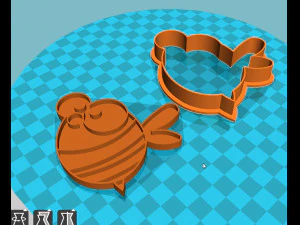 dimarinkaOther
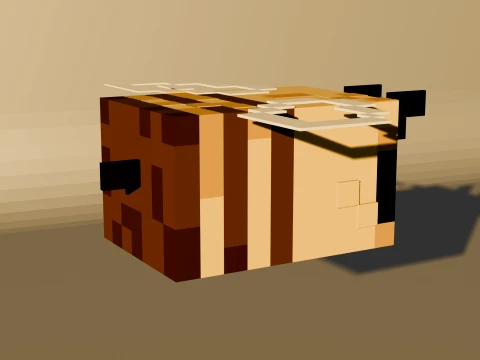

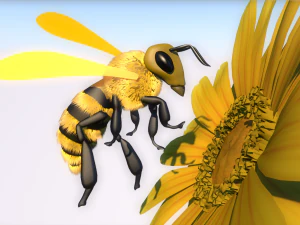
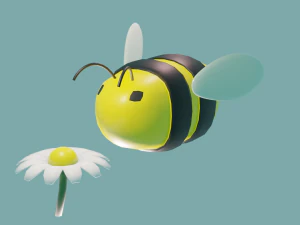
Популярні запити 3D Моделі:
Скульптури 3D Моделі Персонажі 3D Моделі Кухня 3D Моделі Кінь 3D Моделі Архітектурні Екстер'єри 3D Моделі Телефони 3D Моделі Овочі 3D Моделі Ювелірні вироби 3D Моделі Іграшки 3D Моделі Медицина 3D Моделі Вертольот 3D Моделі Важка зброя 3D Моделі Вантажівка 3D Моделі Анатомія 3D МоделіQ1: What anatomical features should a realistic bee 3D model include?
The key details that separate a convincing bee from a generic insect: correct three-part body segmentation (head, thorax, abdomen), two pairs of wings (forewings and hindwings that hook together via hamuli during flight), six legs with correct segment count (coxa, trochanter, femur, tibia, tarsus), compound eye geometry with facet detail, and the characteristic yellow-and-black abdominal banding. The pollen baskets (corbiculae) on the hind legs are a species-specific detail worth including for honeybee models. Wing venation — the network of veins within each wing — is what makes bee wings read as translucent rather than flat plastic. This is best handled through a wing texture with alpha transparency rather than modeled geometry.
Q2: How are bee wing animations typically handled in 3D models?
Wing flapping runs at 200–230 Hz in real honeybees — far too fast to animate frame-by-frame. The standard approach is motion blur combined with a rapid oscillation animation at 30fps that approximates the visual blur of real wing movement. In Blender, animate wing rotation ±45 degrees from neutral over 2–3 frames and loop it — with motion blur enabled at about 0.5 shutter angle, this produces a convincing hovering wing effect. For game engines, a simple two-bone wing rig with a fast procedural oscillation driven by a sine wave in Blueprint or a C# script is more performance-efficient than baked animation at high frame counts.
Q3: Can bee 3D models be used in agricultural or environmental visualization?
Yes — pollination simulation visualizations, agricultural tech product demos, and environmental awareness campaigns all use bee models. For these applications, the behavior animation matters as much as the model quality: landing on flowers, investigating surfaces, taking off, and loading pollen baskets are the key animation states. A pollination visualization typically involves multiple bee instances flying procedural paths between flower models — in Blender, this uses particle systems with a bee object as the instance, following a velocity field that represents the bee's flight pattern. For real-time apps, Unreal's Niagara particle system can drive hundreds of instanced bee characters with procedural movement at interactive frame rates.
Q4: Are there low-poly bee models suitable for mobile AR experiences?
Several sellers offer mobile-optimized bee models under 5,000 triangles with 1K or 2K texture atlases. For AR specifically, the wing transparency is the main technical consideration — translucent materials with alpha have performance costs on mobile GPUs. A cutout alpha (binary transparent) instead of full alpha blend for the wings reduces this cost significantly while still looking correct in most viewing conditions. For ARKit and ARCore in 2026, GLB files with KHR_materials_transmission extension handle wing translucency efficiently. Scale the bee to real-world dimensions (honeybee body approximately 15mm length) in the source file — this makes the AR scale anchoring work correctly without per-session adjustment.